
In a stunning policy reversal which President Trump says he was planning all along, the U.S. has eliminated all tariffs and will encourage cheaper imported goods because Trump says he has forced foreigners to give us real things—cars, computers, steel and coffee—in exchange for almost worthless things—pieces of paper and electrons.
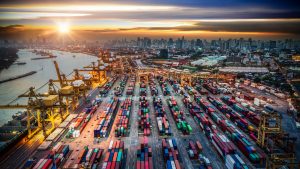 “It’s magnificent,” he posted. “I’ve got them to sell us more stuff than they buy from us, and so we get real, useful things from them, and they get stuck with all those extra dollars. What are they going to do with them? They can just hold them, which costs us nothing, or they can invest the dollars back in the U.S., stimulating growth and jobs, and helping to lower interest rates. It’s a great deal for us!”
To keep this near-scam going in our favor, Trump acknowledged that we need to remain the world’s pre-eminent economy with the world’s reserve currency. “To do that, we constantly have to grow and to innovate, not protect out of date industries, as well as reduce our national debt burden, so those foreign suckers will keep buying our bonds and investing here,” he quipped to reporters on Air Force One.
Then he added, “So we’ll reduce regulations, there’ll be no more government meddling in or protecting businesses, and we’ll drastically reform entitlements to cut back on the deficits. When we do that, our economy will roar, foreigners will keep selling us their stuff at great prices AND investing here, and we’ll have increases in real wages and wealth for every American for decades after I’m gone.”
The President acknowledged that there are some specific industries which, for valid national security reasons or foreign restrictions, need to be assisted or partially controlled. But that can be done on an individual case basis, he said, without disrupting the larger economy.
Beaming, Trump added, “And—this is what’s really great—by getting consumer goods and manufacturing inputs cheaper from overseas, it makes everything more affordable here! Prices go down. People have more money to spend on other things. More jobs are created. It’s big and it’s beautiful.”
_______________________________
Of course the dream described above is actually the “Trade Deficit in Goods and Services” which the U.S. has run for decades. It’s an accounting term, not a moral failing.
Please read, or re-read, my earlier post on The Tariff Whisperer.
The unforced error of high tariffs actually in effect today increases prices and input costs, reduces jobs, reduces our Gross National Product, and, by artificially protecting less-competitive industries, will quickly transform our economy from the world’s leader into one of many followers.
On an issue so well proven by economic theory and actual experience, how can the President be so wrong and so ill-advised?
And by “actual experience” I don’t mean ancient history. The President quickly reduced the tariffs on bananas and coffee when their prices increased dramatically. But we run huge trade deficits with all the countries which supply these staples, so that must be bad, according to the President. Are they “ripping us off” by selling us these goods at low prices, as Trump has said? Yes? Actually, No. Of course not. We could grow coffee and bananas ourselves behind the protection of high tariffs, using greenhouses and technology, but they would cost too much for most Americans and be in very short supply. The same commonsense principle is true for every manufacturing input and consumer good we buy from overseas–we benefit from their lower cost specialization, just like they benefit from ours.
Finally, no one should be allowed to take any government office in America unless he or she has read and reported on Henry Hazlitt’s short, great book, Economics in One Lesson.
The book is full of incredible wisdom. See my earlier post, What We Don’t See Is Killing Us. Here is a short, relevant excerpt from Chapter 15:
“The whole argument for this book may be summed up in the statement that in studying the effects of any given economic proposal we must trace not merely the immediate results but the results in the long run, not merely the primary consequences but the secondary consequences, and not merely the effects on some special group but the effects on everyone…It is foolish and misleading to concentrate our attention merely on some special point—to examine, for example, merely what happens in one industry without considering what happens in all. But it is precisely from the persistent and lazy habit of thinking only of some particular industry or process in isolation that the major fallacies of economics stem.”
A great book and Christmas present!
Enjoy the Holidays with your family, and pray for good, rational policies.

Comments