
It’s almost June 6th, the anniversary of D-Day. For the last several years on this morning I’ve watched at least the first thirty minutes of the incredible movie, Saving Private Ryan, as my sincere but insufficient act of remembrance.
My parents were married in Baltimore on June 3, 1944, and they tell the story of waking up while on their honeymoon three days later at the Waldorf Astoria Hotel in New York as church bells pealed across the entire city early that morning, and people flooded into churches and cathedrals to pray.
I want to again thank Retired Royal Marines Lieutenant Colonel Eddie Parks and his amazing historian wife, Sharon, at Chateau de Beaulieu Normandy, where my wife and I visited last spring.
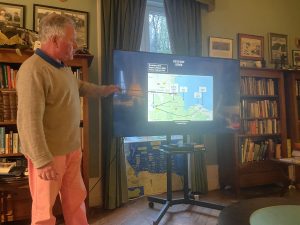 After a three-day drive around Cornwall in southwest England, we took the ferry across the English Channel from Poole to Cherbourg, where the Parks picked us up to begin a three-day immersion into all the details of the D-Day landings. They’ve been doing small group Normandy immersions from their own chateau for over twenty years. If Normandy is on your Bucket List, this is absolutely the way to do it.
We came away utterly humbled by the experience.
In this post I want to make a couple of observations about D-Day, looking from both ends of the telescope—the big and the small. It’s a huge endeavor about which so much has been written; the numbers are so large as to almost lose their meaning. So, with the help of Claude AI to gather information, I’m going to focus on a small piece of the overall effort, and hopefully by doing so create a new appreciation for all the myriad details in the much larger operation.
Glider warfare is probably not a subject you’ve thought much about, but it was essential to D-Day, as well as to several of the key battles over the next year.
In 1944 there were no helicopters. If you had to put a large number of fighting men behind enemy lines, there were two choices: paratroops and gliders.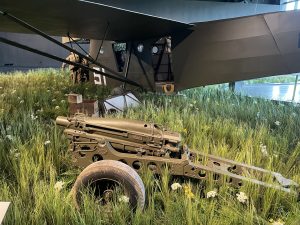 The flanks of any beach assault had to be secured before the seaborne forces landed — but parachute infantry, while useful, scattered badly in darkness and couldn’t deliver heavy equipment, vehicles, or men in tight tactical formations. You cannot seize a bridge with a platoon scattered across three kilometers of Norman hedgerow.
Powered aircraft were useless for this role — they couldn’t land troops precisely behind enemy lines and fly out again. The answer, resurrected from a concept tested by the Germans at Fort Eben-Emael in Belgium in May 1940, was the military glider. Silent, capable of landing a full platoon together on a pinpoint target, the glider was essentially a flying truck that you used once.
Operation Deadstick (British 6th Airborne Division, D Company, Ox and Bucks) targeted two bridges over the Caen Canal and the Orne River in Normandy near Ranville — known to history as Pegasus Bridge and Horsa Bridge. These crossings were the only route by which German armored forces could quickly reinforce the eastern flank of the Allied beach landings. If the Germans held these bridges, they could pour armor onto Sword Beach from the east and potentially roll up the entire British landing. The bridges had to be seized intact before dawn — before the Germans could blow them — and held until seaborne and airborne reinforcements arrived. Six British Horsa gliders would carry D Company under Major John Howard: three to each bridge.
Operation Chicago and Operation Detroit (American 82nd and 101st Airborne Divisions) used Waco CG-4As primarily to deliver artillery and heavy equipment to support the parachute infantry already dropping into the Cotentin Peninsula. The Wacos could bring in 57mm antitank guns, Jeeps with trailers, and ammunition that the paratroopers simply could not carry.
At 2256 hours on June 5, six Halifax bombers at Tarrant Rushton airfield began their take-off rolls, each towing a Horsa on a 300-foot nylon rope. The pilots of D Company sat in the darkness of their aircraft, packed shoulder to shoulder with men who had trained together for a year. Below them, the English Channel began to pass under the clouds.
The navigation to the target was a masterpiece of planning and execution. The glider pilots, after crossing the Channel at low altitude to avoid German radar, cast off their tow ropes at approximately 6,000 feet over the French coast. They were now committed — no engine, no second chance, no going around. In total silence broken only by the rush of air over fabric and wood, six gliders turned onto their final headings.
Staff Sergeant Jim Wallwork, piloting the lead Horsa for Pegasus Bridge, flew his approach using a stopwatch and the moonlight reflecting off the river below. At approximately 0016 hours on June 6, his glider crossed a hedge at about 90 miles per hour, the skids hit the turf of a small field, and the Horsa careened across the ground in a shower of sparks and snapping wood, stopping with its nose buried in the German wire at the edge of the bridge.
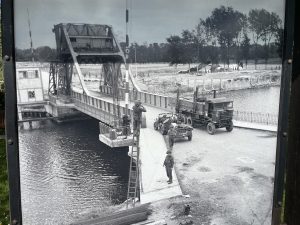 The elapsed time from cast-off to landing: approximately twelve minutes. The elapsed time from Wallwork’s crash-landing to D Company soldiers seizing the bridge: approximately ten minutes.
Two of the three Horsas bound for Pegasus Bridge landed within 47 meters of their target — a feat of precision flying in total darkness that has never been fully equaled. The third landed several miles away at the wrong bridge (the Dives rather than the Orne) — a navigation error that, as it happened, contributed to German confusion about where the real threat was.
The American Waco missions later that night and into the early morning of June 6 were considerably more dispersed and costly. Many Wacos were shot down or crash-landed in unfamiliar terrain, their loads destroyed or scattered. The 82nd and 101st Airborne’s glider missions suffered approximately 50 percent casualties in equipment and significant losses in personnel, though much of what survived proved invaluable in the hedgerow fighting that followed.
That’s the “small end” of the telescope. The above paragraphs, summarized by Claude AI, describe what gliders and their heroic crews accomplished during only about twelve hours on June 6th. My wife and I stood at Pegasus Bridge with Eddie Parks and walked the adjoining field in which the British gliders landed in the dark, right next to it. As I said above, it was just humbling.
But equally humbling is to turn the telescope around and to study how all those gliders wound up in Southeast England on June 5th, ready to fulfill their role in the invasion.
Neither the US nor the UK had any military glider capacity before the war. As noted above, their use by Germany in Belgium in 1940 awakened the Allies’ interest.
The Aircraft: Two Gliders for Two Armies
The American Waco CG-4A
The United States Army Air Forces contracted with the Waco Aircraft Company of Troy, Ohio in 1941 for what would become the most produced military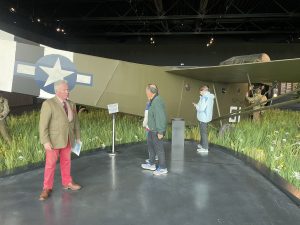 glider in history. The CG-4A (Cargo Glider, 4th model, 1st variant) was a high-wing monoplane of welded steel tube fuselage and spruce/fabric construction — deliberately simple so it could be manufactured by furniture makers, piano companies, and coffin manufacturers retooled for war production. Ultimately, fifteen different manufacturers built approximately 13,909 of them.
Key specifications told the tactical story: a wingspan of 83 feet 8 inches, a cargo capacity of 3,750 pounds, and a hinged nose that swung upward to allow direct loading of a Jeep, a 75mm pack howitzer, or 13 fully equipped infantrymen. Crucially, it could land in a space roughly the size of a football field and come to a stop in 200-300 feet with a nose-up stall landing.
The Waco was not a comfortable aircraft. Pilots sat in a large Plexiglas nose that offered spectacular visibility and terrible protection. The cockpit was unheated. The controls were heavy and sluggish under load. Pilots described it as honest but unforgiving — it flew predictably right up until it didn’t.
The British Airspeed Horsa
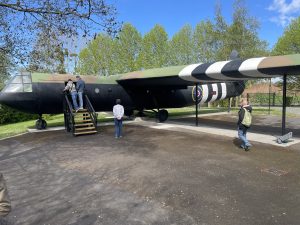 British engineers at Airspeed Ltd., working under specifications issued in late 1940, designed a substantially larger aircraft. The Horsa Mark I had a wingspan of 88 feet, could carry 25 fully equipped troops or a Jeep and antitank gun combination, and weighed nearly 8,400 pounds empty. Like the Waco, it used wood and fabric construction — specifically laminated spruce — so that the British furniture industry could manufacture it without consuming strategic aluminum.
The Horsa had one feature the Waco lacked that proved decisive at Pegasus Bridge: its tail section could be unbolted in the field in minutes, allowing the rapid unloading of vehicles and guns from the rear. It also had a two-pilot cockpit with dual controls and was considered by most who flew it to have better handling characteristics than the Waco under heavy loads.
The Horsa that secured Pegasus Bridge was specifically the vehicle used by Major John Howard’s D Company, 2nd Battalion Oxfordshire and Buckinghamshire Light Infantry — six Horsas carrying 181 men.
Manufacturing and the Industrial Mobilization
The production story of the Waco CG-4A is one of the more remarkable industrial improvisations of the war. Because the aircraft used no critical war materials — no aluminum, no exotic alloys — the Army Air Forces turned to America’s woodworking industries. Companies including the Gibson Guitar Company, the Steinway Piano Company, the Presto Recording Corporation, and dozens of furniture manufacturers received contracts. Quality control was a persistent nightmare. Several catastrophic structural failures during training — including the deaths of ten prominent officials including the mayor of St. Louis during a 1943 demonstration flight — forced a full review of manufacturing standards and the introduction of stricter inspection regimes.
The British Horsa, produced by Airspeed Ltd. and subcontracted to furniture manufacturers throughout Britain, presented similar challenges. The laminated spruce construction was labor intensive and the tolerances demanding. The aircraft were often built in sections by different manufacturers, then assembled at dedicated facilities.
The Atlantic Ferry and Reassembly
Getting the Wacos from American factories to British airfields was itself an extraordinary logistics problem. Unlike powered aircraft, gliders could not fly the Atlantic under their own power.
The most direct was disassembly, crating, and shipment by sea — the same Atlantic convoys that carried tanks, ammunition, and food. A Waco CG-4A, stripped of its wings and with its fuselage sections nested, could be packed into large wooden crates and stacked on cargo ships. The hazards of the North Atlantic — U-boats, weather, and the occasional torpedoed transport — meant that some gliders went to the bottom of the ocean before they ever saw England.
Upon arrival in the United Kingdom, crated gliders were trucked to designated reassembly depots, where teams of mechanics — often working with aircraft they had never seen before — bolted the aircraft back together, rigged the control cables, checked the flight surfaces, and cleared them for test flights. The pace of delivery and reassembly accelerated dramatically through late 1943 and into the spring of 1944, as Overlord’s launch date approached.
Training the Crews
The glider pilots of both the American 101st and 82nd Airborne Divisions and the British 6th Airborne Division were among the most uniquely trained soldiers of the war — and unlike conventional aviators, they were also expected to fight as infantry once they landed.
American glider pilots were trained through the Army Air Forces Glider Training Program, which went through several chaotic iterations before settling into a workable curriculum. Candidates began on powered light aircraft — typically the Piper Cub — to develop basic airmanship, then graduated to the TG-series training gliders before moving to the Waco CG-4A. The full course ran approximately seven months. The Army’s peculiar bureaucratic ambivalence about glider pilots — they were flight officers, neither fully commissioned officers nor enlisted men — created persistent morale problems. They received no automatic continuation training after completing the course, and many sat idle for months before being committed to combat.
The pilots who would fly into Normandy practiced again and again on the English countryside, learning to recognize landmarks in the dark, to judge glide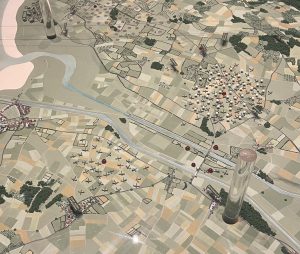 paths over hedgerows, and to put a fully loaded CG-4A into a confined field. They practiced emergency procedures: what to do when the tow rope snapped (it did, regularly), what to do when the load shifted (it could, fatally), what to do in rain, in cloud, in fog.
British glider pilots of the Glider Pilot Regiment occupied a different institutional niche. Formed in 1942 under Colonel George Chatterton, the Regiment explicitly trained its men as “total soldiers” — competent enough as pilots to navigate and land in combat, and then immediately effective as infantry or artillery crew. This dual role shaped the entire training philosophy. British glider pilots qualified on the Hotspur trainer, then progressed to the Horsa, and received infantry training concurrently. By D-Day, the Glider Pilot Regiment’s men had been trained to the standard of a capable light infantryman in addition to their aviation skills.
Other Requirements
Of course in addition to all of the above, every glider on D-Day required a powered aircraft with pilots and crew to tow it. These had to be assembled, trained and precisely organized, ready to mate with all the assigned gliders in an intricate ballet, on the ground and then in the air.
Plus all the human logistics of housing, feeding and transporting all the crews, support staff, and assigned fighting units to wind up in the right glider behind the right aircraft at the right time.
Here’s my second humbling observation: Everything described above was successfully accomplished for just one tiny part, the gliders, for one major operation in the war. Multiply that complexity of achievement across the entire war effort in both Europe and the Pacific, and it simply astounds me that so much was accomplished by our nation, and by our Allies, in so little time.
 And as we consider what was done, keep in mind that none of the following existed: jet aircraft, satellites, cellphones, the internet, corporate or personal computers, word processors, fax machines, copy machines, memory typewriters, digital cameras, four-function calculators, search engines, or videos. If you needed to tell someone something, you either had to meet with them face-to-face, send a human messenger, write them a letter or telegraph, or call their home or business phone and hope that they were there and answered. There were no other options.
It was simply an amazing achievement, accomplished by a nation largely united around a single goal. And, thankfully, one of the byproducts was the beginning of the end for racial segregation and gender stereotyping. Those efforts would continue across the next two decades, but they achieved real-world traction as a result of our all-hands-on-deck need for every bit of human resources in World War II.
We certainly don’t need a war. But we just as certainly could use more of the unity in our nation today that was America during those four years.
Finally, if you’d like to see an incredible documentary video on how D-Day almost failed at the point of the spear on Omaha Beach, watch here, as recommended by Sharon Parks. It gives the real-world facts around the story so vividly portrayed in Saving Private Ryan.
Enjoy your day, and be thankful for all those who made, and continue to make, our freedom possible.
If you’d like to receive these monthly posts in your In Box, please subscribe on Substack with this link: https://bit.ly/4p2soRt.


Comments